
What better post could there be to resume my venture after a career break spent balancing motherhood and life as a space engineer? My last post was back in 2024, but the space industry hasn’t stood still since — a lot has changed, and Artemis III is one of the clearest examples of it. Fittingly, this mission has gone through its own restructuring, moving through stages of demonstration and testing in low Earth orbit before committing to the real thing. Not so different, in some ways, from my own journey these past couple of years.
A quick note before we dive in: this post may contain affiliate links — things like books, models, or gear related to space and engineering that I genuinely like and think you might too. If you click through and buy something, I may earn a small commission at no extra cost to you. It doesn’t change what I write or how I write it; it just helps keep this blog running while I get back into the swing of things. Thanks for supporting SpaceDani.
In this post, I’m breaking down exactly what changed when NASA redefined Artemis III earlier this year, and why testing in Earth orbit before attempting a lunar landing is, in my view, the most important call NASA has made in this entire campaign. I’ll walk you through the full mission sequence — launch to splashdown, three rockets, two dockings, and a control handoff that’s never been attempted on a crewed flight before. We’ll look at exactly how this mission differs from what most people still picture when they hear “Artemis III.” I’ll give you the latest status on Orion, Blue Moon and Starship Human Landing System (HLS) side by side.
Artemis III Mission Redefined
On February 27, 2026, NASA Administrator Jared Isaacman restructured the entire Artemis III flight sequence. What was supposed to be the first crewed lunar landing since Apollo 17 is now a crewed demonstration mission in low Earth orbit. The actual lunar landing has shifted to Artemis IV, targeted for 2028.
Honestly, in my opinion, this is one of the most important reconsiderations NASA has made before the actual lunar landing. Shifting the mission’s objective to demonstrate rendezvous, docking, and crew transfer procedures in the relative safety of low Earth orbit — rather than a quarter million miles from home — just makes sense. With both SpaceX and Blue Origin building the hardware this mission depends on, there are more moving parts and more interfaces that have to work together perfectly; if even one doesn’t, the whole mission could be jeopardized. When humans are involved, real-time testing has to happen so that every one of those systems works, every single time, with no room for a bad day. And with multiple organizations in the mix, testing in this demonstration stage is exactly how you surface the failure points before they show up somewhere far less forgiving.
Artemis III Mission Sequence
First lets understand the mission sequence before we dive deeper into the mission specifics. Artemis III now requires three separate launches converging in the same orbit: SLS carrying Orion and its crew, a SpaceX mission delivering a Starship HLS pathfinder, and a Blue Origin New Glenn rocket carrying a Blue Moon Mark 2 pathfinder.
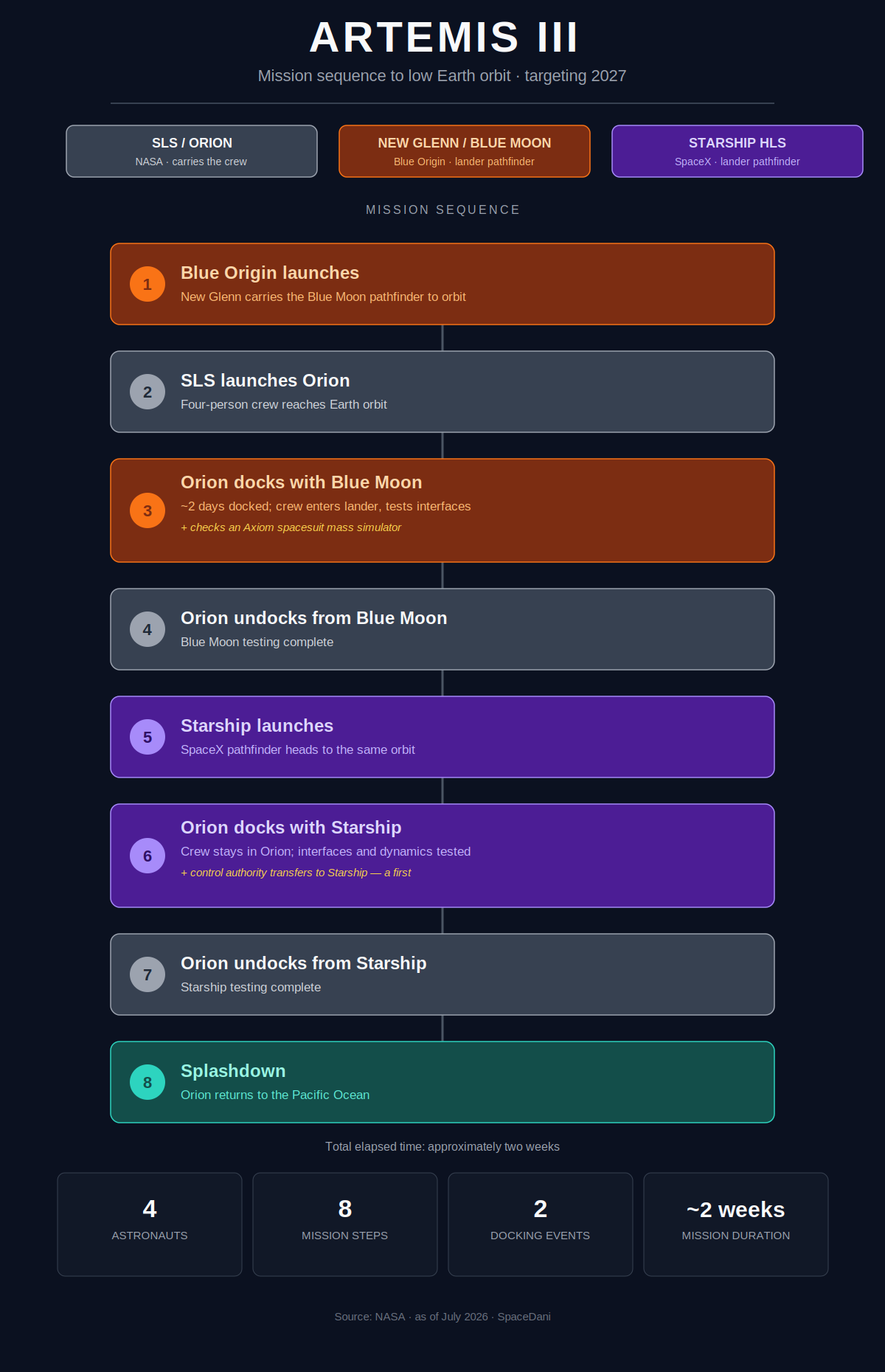
How is Artemis III different ?
A Collaborative Effort
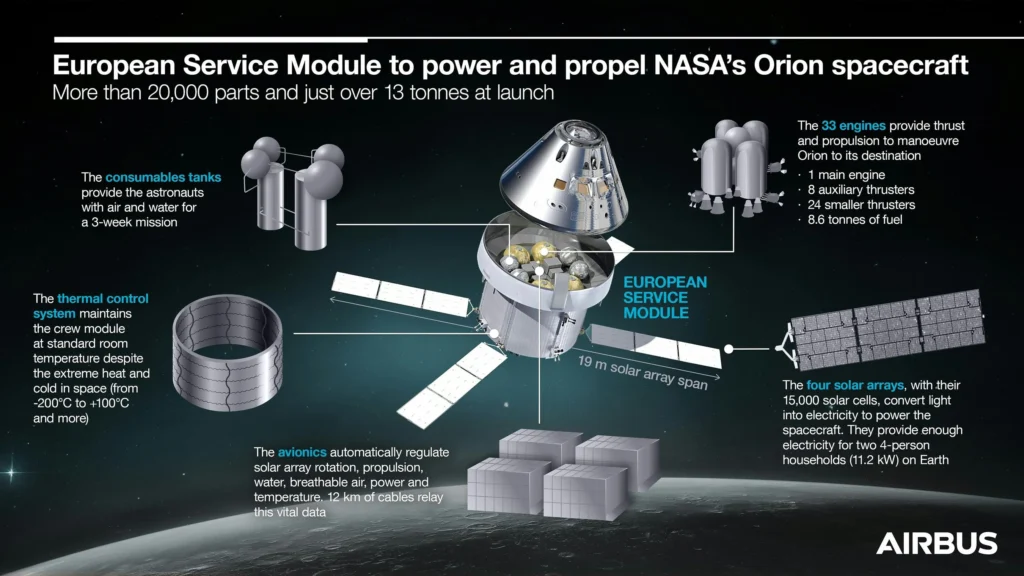
Along with commercial partners like Blue Origin and SpaceX, there’s another piece to this puzzle that rarely gets talked about. Orion’s service module is a European Service Module (ESM), built by Airbus Defence and Space in a pan-European effort, drawing engineers from more than 20 companies across 10 countries. The design is derived from Europe’s Automated Transfer Vehicle, the cargo ship once used to resupply the ISS. Life support essentials — water, oxygen, and nitrogen — along with managing the spacecraft’s temperature throughout the Artemis III mission, will be handled by a system built by Thales Alenia Space Italia.
The Powerhouse of Orion
The Artemis III mission will be performed entirely in low Earth orbit. SLS won’t use an Interim Cryogenic Propulsion Stage (ICPS) for a trans-lunar burn this time; instead, NASA plans to save the ICPS for Artemis IV and fly a non-propulsive structural spacer in its place. That means the European Service Module alone has to provide power, thermal control, and propulsion for Orion — including the entire circularization burn needed to place Orion into its target orbit, roughly 460 km up at a 33-degree inclination. This orbit was chosen specifically because it gives Orion, the Blue Moon pathfinder, and the Starship pathfinder more launch windows per day than a lunar-bound trajectory would, increasing the odds of staying on schedule and getting every system properly tested.
Testing Two Landers, One After Another
The Blue Moon docking is built to test the crew module itself — astronauts actually go inside and check out the life-support interfaces, since Blue Moon shares hardware with the real Mark 2 lander. The Starship docking, by contrast, is built to test integrated flight control of a much larger vehicle, culminating in that mid-mission authority handoff where Starship’s computer takes over the stack. Running these back-to-back rather than concurrently keeps each test isolated, so if something goes wrong, engineers know exactly which system caused it.
Current status
Orion — In the Final Phase of Assembly
- Heat shield: Orion’s heat shield was installed on July 13, 2026, inside Kennedy’s Neil Armstrong Operations and Checkout Building. This 16.5-foot-diameter shield is made up of 186 upgraded blocks of ablative AVCOAT, incorporating design fixes based on the localized erosion patterns discovered on the uncrewed Artemis I flight.
- Orion’s European Service Module: ESM-3 uses a repurposed Space Shuttle Orbital Maneuvering System (OMS) engine — recycled shuttle-era hardware — producing about 26.6 kN of thrust, backed up by 8 auxiliary R-4D engines plus 24 smaller thrusters for attitude control. All of them run on a hypergolic propellant combination of MON-3 and monomethylhydrazine (MMH), which ignites on contact without needing a separate ignition source — a reliability advantage for a system that absolutely cannot fail. ESM-3 also carries four distinctive “X-wing” solar arrays generating roughly 11 kW. It has completed direct-field acoustic testing (D-FAT) at Kennedy Space Center — the same method used on ESM-2, in which engineers surround the module with columns of speakers generating nearly 140 decibels, comparable to a jet engine at takeoff, to confirm the hardware can survive the noise and vibration of an actual SLS launch.
- SLS booster stacking: On July 11, 2026, the twin solid rocket boosters began stacking, starting with the left-hand aft segment. Artemis III crew members Randy Bresnik and Andre Douglas were on hand to witness it.
- RS-25 engines — now fully delivered: L3Harris shipped the final two of Artemis III’s four RS-25 engines to NASA’s Michoud Assembly Facility on July 22, 2026, completing delivery of the full engine set. Artemis III also introduces a first for the program: technicians will integrate the engines with the core stage while it stands vertically, rather than horizontally as on every prior SLS mission — the same orientation the rocket will hold on the launch pad itself.
- Crew and service module integration underway: With heat shield installation complete, teams at Kennedy are now moving into final preparations to physically join Orion’s crew module to ESM-3 — the last major structural milestone before the fully assembled spacecraft heads toward integrated testing with the rest of the rocket.
Blue Moon vs. Starship: Specs, Artemis III Readiness & What’s Left
| Blue Moon | Starship HLS | |
|---|---|---|
| Main engine | BE-7 (×3), cryogenic LH2/LOX | Raptor 3, cryogenic methalox |
| Pathfinder propulsion | (Mark 2) Flies without a complete propulsion system | Full Raptor propulsion retained |
| Docking system heritage | (Mark 2) Not publicly detailed | Derived from SpaceX’s flight-proven Dragon 2 |
| Design confirmed for Artemis III | (Mark 2) Yes — real crew cabin (confirmed July 6) | Yes — docking-capable |
| Docking system tested | (Mark 2) Not publicly disclosed | 200+ simulated dockings at JSC |
| Life support validation | (Mark 2) Fuel cells tested (Jan 2026); functioning system lets crew enter the pathfinder cabin | Not applicable — pathfinder carries no active life support, crew stays in Orion |
| Ground/training hardware | (Mark 2) Full-scale cabin mock-up operational at NASA JSC | Not publicly confirmed |
| Most recent milestone | Paused New Shepard flights to redirect resources to lunar landers | Flight Test 13 launched successfully July 24 |
| Lander hardware status | (Mark 1, Endurance) In “quiescent operations,” awaiting launch | Tied to the broader Block 3 flight-test campaign |
| Launch vehicle status | Grounded; LC-36 targeted for late 2026 | Flying regularly; Flight 13 succeeded July 24 |
| Human-rating certification | (Mark 2) Not completed | Not completed |
| Core Artemis III dependency still unproven | New Glenn’s return to flight | Orbital ship-to-ship propellant transfer |
| In-space refueling need (full vehicle) | (Mark 2) Dedicated Lunar/Cislunar Transporter | ~10+ tanker launches to fill an orbital depot |
| Next confirmed target | (Mark 1, Endurance) Launch, no earlier than Q1 2027 | Flight 14, targeting orbit and a booster catch |
At its core, Artemis III is a lesson in reliability engineering. Not one big leap of faith. Every failure point is isolated and tested, before a human life can be risked. Rendezvous, docking, and control handoffs are tested in low Earth orbit — not a quarter million miles from home. That’s disciplined risk reduction, put into practice. That same lesson has been relearned by me these past two years. Nothing worth trusting is built in one clean leap. It is tested, adjusted and proven in small, safe steps first. The next twelve months aren’t guaranteed. But if a place is earned here by Orion, Starship, and Blue Moon, Artemis IV’s landing will be built on tested ground — not hope. The same, I hope, will be earned by me.
If this is your first time here — welcome, and thanks for reading all the way through. If you’ve been here before 2024 — thank you for waiting. Either way, I’ll be back with updates as this mission keeps moving.
Sources
Sources
Mission restructuring & overview
- NASA — Artemis III mission page: https://www.nasa.gov/mission/artemis-iii/
- NASA — NASA Outlines Preliminary Artemis III Mission Plans: https://www.nasa.gov/missions/artemis/artemis-3/nasa-outlines-preliminary-artemis-iii-mission-plans/
- Wikipedia — Artemis III: https://en.wikipedia.org/wiki/Artemis_III
- SatNews — NASA Outlines Preliminary Artemis III Low Earth Orbit Test Flight Profile: https://satnews.com/2026/05/18/nasa-outlines-preliminary-artemis-iii-low-earth-orbit-test-flight-profile/
- Interesting Engineering — Artemis III to rehearse Orion spacecraft docking in low Earth orbit: https://interestingengineering.com/space/nasa-artemis-iii-orion-spacex-docking
- TechTimes — Artemis III Docking Sequence Revealed: Orion Hands Control to Starship Mid-Mission: https://www.techtimes.com/articles/320707/20260716/artemis-iii-docking-sequence-revealed-orion-hands-control-starship-mid-mission.htm
SLS & Orion hardware progress
- NASA — NASA’s Artemis III Moon Rocket Hardware Arrives, Artemis II Capsule Returns to Kennedy: https://www.nasa.gov/blogs/missions/2026/04/28/nasas-artemis-iii-moon-rocket-hardware-arrives-artemis-ii-capsule-returns-to-kennedy/
- NASA — Artemis blog (booster stacking, heat shield installation updates): https://www.nasa.gov/blogs/artemis/
- Aerospace America — NASA, Lockheed Martin say Artemis III advancing, facing milestones this year: https://aerospaceamerica.aiaa.org/nasa-lockheed-martin-say-artemis-iii-advancing-facing-milestones-this-year/
Orion spacecraft & European Service Module (ESM-3)
- Wikipedia — Orion (spacecraft): https://en.wikipedia.org/wiki/Orion_(spacecraft)
- Wikipedia — European Service Module: https://en.wikipedia.org/wiki/European_Service_Module
- Lockheed Martin — Docking Orion: Choreographing a Space Dance: https://www.lockheedmartin.com/en-us/news/features/2025/docking-orion.html
- ESA — ESA astronaut Luca Parmitano joins NASA’s Artemis III mission as pilot: https://www.esa.int/Science_Exploration/Human_and_Robotic_Exploration/ESA_astronaut_Luca_Parmitano_joins_NASA_s_Artemis_III_mission_as_pilot
- ESA — European Service Module at the (space) disco (ESM-3 acoustic testing): https://www.esa.int/ESA_Multimedia/Images/2026/05/European_Service_Module_at_the_space_disco
- ESA — ESA delivers again: ESM-3 departs for US to power Artemis III: https://www.esa.int/Newsroom/Press_Releases/ESA_delivers_again_ESM-3_departs_for_US_to_power_Artemis_III
- NASA — Orion’s Artemis III European Service Module Joined with Crew Module Adapter: https://www.nasa.gov/blogs/missions/2024/09/27/orions-artemis-iii-european-service-module-joined-with-crew-module-adapter
- Airbus — Orion European Service Module for NASA’s Artemis: https://www.airbus.com/en/products-services/space/space-exploration/moon-missions/orion-european-service-module
RS-25 engines & heat shield
- NASA — SLS RS-25 Core Stage Engine reference page: https://www.nasa.gov/reference/space-launch-system-rs-25-core-stage-engine/
- L3Harris — RS-25 Engine: https://www.l3harris.com/all-capabilities/rs-25-engine
- Wikipedia — RS-25: https://en.wikipedia.org/wiki/RS-25
Starship HLS
- NASA, SpaceX Test Starship Lunar Lander Docking System: https://www.nasa.gov/image-article/nasa-spacex-test-starship-lunar-lander-docking-system/
- Wikipedia — Starship Propellant Transfer Demonstration: https://en.wikipedia.org/wiki/Starship_Propellant_Transfer_Demonstration
- Yahoo News — SpaceX says Starship is leading the charge back to the moon: https://www.yahoo.com/news/articles/spacex-says-starship-leading-charge-233055784.html
- NASASpaceFlight.com — Starship Block 3 and HLS: The path to get back to the Moon: https://www.nasaspaceflight.com/2025/11/starship-block-3-path-moon/
Blue Moon Mark 1 & Mark 2
- Universe Magazine (via SpaceNews) — Blue Origin’s lunar program continues despite the explosion: https://universemagazine.com/en/blue-origins-lunar-program-continues-despite-the-explosion/
- NASASpaceFlight.com — After New Glenn anomaly, Blue Origin keeps focus on upcoming Blue Moon and Mars missions: https://www.nasaspaceflight.com/2026/06/blue-moon-mto-update/
- SatNews — Blue Origin Insulates Lunar Landers from Launch Pad Recovery Fallout: https://satnews.com/2026/07/06/blue-origin-insulates-lunar-landers-from-launch-pad-recovery-fallout/
- NASA — Industry Moon Lander Training Cabin Lands at NASA for Artemis: https://www.nasa.gov/directorates/esdmd/artemis-campaign-development-division/human-landing-system-program/industry-moon-lander-training-cabin-lands-at-nasa-for-artemis/
- Space.com — Blue Origin’s lunar lander mockup is ready for NASA Artemis astronaut training: https://www.space.com/space-exploration/artemis/blue-origins-lunar-lander-mockup-is-ready-for-nasa-artemis-astronaut-training
- Spaceflight Now — Blue Origin details lunar exploration progress amid Artemis 3 contract shakeup: https://spaceflightnow.com/2025/10/28/blue-origin-details-lunar-exploration-progress-amid-artemis-3-contract-shakeup/
- Wikipedia — Blue Moon (spacecraft): https://en.wikipedia.org/wiki/Blue_Moon_(spacecraft)
- Wikipedia — BE-7: https://en.wikipedia.org/wiki/BE-7
- TalkOfTitusville — Blue Origin Making Steady Progress With Its Lunar Lander: https://talkoftitusville.com/2026/05/06/blue-origin-making-steady-progress-with-its-lunar-lander/
- Spaceflight Now — NASA head urges new launcher for Blue Origin’s moon landers to meet Artemis mission deadlines: https://spaceflightnow.com/2026/06/04/nasa-head-urges-new-launcher-for-blue-origins-moon-landers-to-meet-artemis-mission-deadlines/
- Spaceflight Now — Blue Origin outlines return to flight logistics for its New Glenn rockets: https://spaceflightnow.com/2026/06/30/blue-origin-outlines-return-to-flight-logistics-for-its-new-glenn-rockets/
- NASA — NASA to Support Blue Origin New Glenn Rocket Testing, Advance Artemis (Stennis B-2 test stand agreement): https://www.nasa.gov/news-release/nasa-to-support-blue-origin-new-glenn-rocket-testing-advance-artemis/
- SpaceNews — Blue Origin continues work on lunar landers during recovery from New Glenn explosion: https://spacenews.com/blue-origin-continues-work-on-lunar-landers-during-recovery-from-new-glenn-explosion/
- Futurism — Jeff Bezos’ Moon Lander Just Completed a Key Test: https://futurism.com/space/jeff-bezos-moon-lander-completed-test
Latest updates
- Wikipedia — Starship flight test 13: https://en.wikipedia.org/wiki/Starship_flight_test_13
- Spaceflight Now — Super Heavy-Starship rocket chalks up mostly successful test flight: https://spaceflightnow.com/2026/07/25/super-heavy-starship-rocket-chalks-up-mostly-successful-test-flight/
- Space.com — SpaceX Starship Flight 13 launch updates: https://www.space.com/news/live/spacex-starship-flight-13-launch-updates-july-24-2026
- CNN — SpaceX Starship megarocket hits key milestones in ‘Lucky 13’ test flight: https://www.cnn.com/2026/07/24/science/live-news/spacex-starship-flight-13-launch
- Space.com — Starship in space! Highlights of SpaceX megarocket’s epic Flight 13 test launch: https://www.space.com/space-exploration/launches-spacecraft/starship-in-space-see-highlights-of-spacex-megarockets-epic-flight-13-test-launch-video
- Space.com — ‘Full steam ahead’: NASA ramps up prep for Artemis III astronaut launch in 2027: https://www.space.com/space-exploration/artemis/full-steam-ahead-nasa-ramps-up-prep-for-artemis-iii-astronaut-launch-in-2027
- Starlust — Artemis III update: NASA begins assembling its SLS rocket at Kennedy Space Center: https://starlust.org/artemis-iii-update-nasa-begins-assembling-its-sls-rocket-at-kennedy-space-center/
- autoevolution — Blue Origin to Test New Glenn Second Stage at NASA’s Stennis Space Center: https://www.autoevolution.com/news/blue-origin-to-test-new-glenn-second-stage-at-nasas-stennis-space-center-273447.html
- Blue Origin — Official news page (New Shepard pause to accelerate lunar lander development): https://www.blueorigin.com/news